FIBER: HOW TO BE FULL OF IT AND FEEL GOOD!
Week 2: Shopping for Fiber
 | 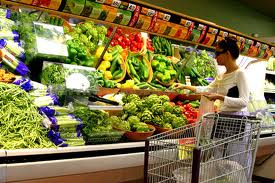 |
This week we will be taking our fiber knowledge and applying it in a local grocery store. A lesson will be taught in the store about healthy shopping practices and food choice, how to select ripe and high fiber foods, and how to prepare your selection of food from the store. You will be able to walk around and apply your new knowledge by selecting a high fiber food to take home with you. You will also receive laminated recipe cards, which are yours to keep. At home, try different cooking methods and recipes with your selected food!
We will be meeting at Publix Supermarket on Thomasville Road. For directions and maps click here
Healthy Shopping Practices and Food Choices
Substitute whole grains for refined, such as whole-wheat bread instead of white bread. Fresh is the best! Fresh fruits and vegetables are always great choices for fiber. Don't forget to check the food label on any item to make sure you are picking the best option-- 3 grams or more of dietary fiber is best. Remember that a variety of foods and food groups each day is the way to go.
How to Prepare your Selections
Most fruits and vegetables should be eaten with the peel (as said last week) to gain its full fiber potential. Fruits and vegetables are best fresh to gain the maximum nutrients. Steaming, stewing, and roasting are also low-fat, low-calorie choices. Next week we will be discussing specific recipes you can use for your fiber-rich ingredients.
More information on fiber-rich foods can be found here
Reading a Nutrition Facts Label
1. At the top of a label, there is the standard serving size of the food item and the number of servings in the food item. This is important because all of the nutritional facts following are based off of the serving size 2. Below are the Calories per serving and the Calories from fat. Generally, 40 Calories per serving is considered "Low Calorie", 100 Calories per serving is considered "Moderate Calorie", and 400 or more Calories is considered "High Calorie". 3. Total fat, saturated fat, trans fat, cholesterol, and sodium (highlighted in yellow) are nutrients that should be limited for better health. 4. Dietary fiber, vitamins, and minerals (ex: vitamin A, vitamin C, calcium, iron, etc.) (highlighted in blue) should be consumed in greater amounts. 5. At the bottom, the footnote explains the nutrient goals for both a 2,000 and 2,500 Calories diet and explains that the percent daily values are based on a 2,000 Calorie diet. 6. The percent daily value on the right (highlighted in purple) indicates the amount of a nutrient provided by a serving when compared to the recommendations for a 2,000 Calorie diet. | 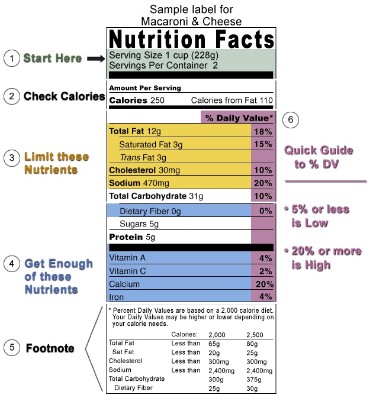 |
To Do:
- Quiz
- Purchase two high-fiber foods from the grocery store to try
- Select a recipe for a high-fiber dish to prepare for week 4
